History
San José began as a farming village of fourteen settlers and their families on the banks of the Guadalupe River. It became California’s first civilian town, its first state capital, the market town of the richest orchard valley in the country, and then the largest city in the Bay Area.

A short history of San Jose
San José began as a farming village of fourteen settlers and their families on the banks of the Guadalupe River. It became California’s first civilian town, its first state capital, the market town of the richest orchard valley in the country, and then the largest city in the Bay Area. This page tells that story in short, with a link to the source for every claim. For the full texts of the old books, see the reading list.
The first people
For thousands of years before the Spanish arrived, the Santa Clara Valley was home to the Tamien people, part of the Ohlone, who spoke the Tamyen language [1]. They used the red cinnabar of the southern hills, the ore of mercury, to make paint [10]. After 1777 most Tamien were taken into Mission Santa Clara or Mission San José, and a large majority died of disease in the missions or in the violence that followed [1].
A town for farmers, 1777
In 1776 Juan Bautista de Anza, returning from San Francisco, chose two sites in the Santa Clara Valley: a mission on the west bank of the Guadalupe River and a civilian town on the east bank [1]. On November 29, 1777, Lieutenant José Joaquín Moraga arrived with fourteen settlers and their families, colonists Anza had led to California, and founded the Pueblo de San José de Guadalupe [2]. It was the first town in Spanish California that was neither a mission nor a military post, and its job was to grow food for the presidios at San Francisco and Monterey [2]. A year later it had 68 people [2].
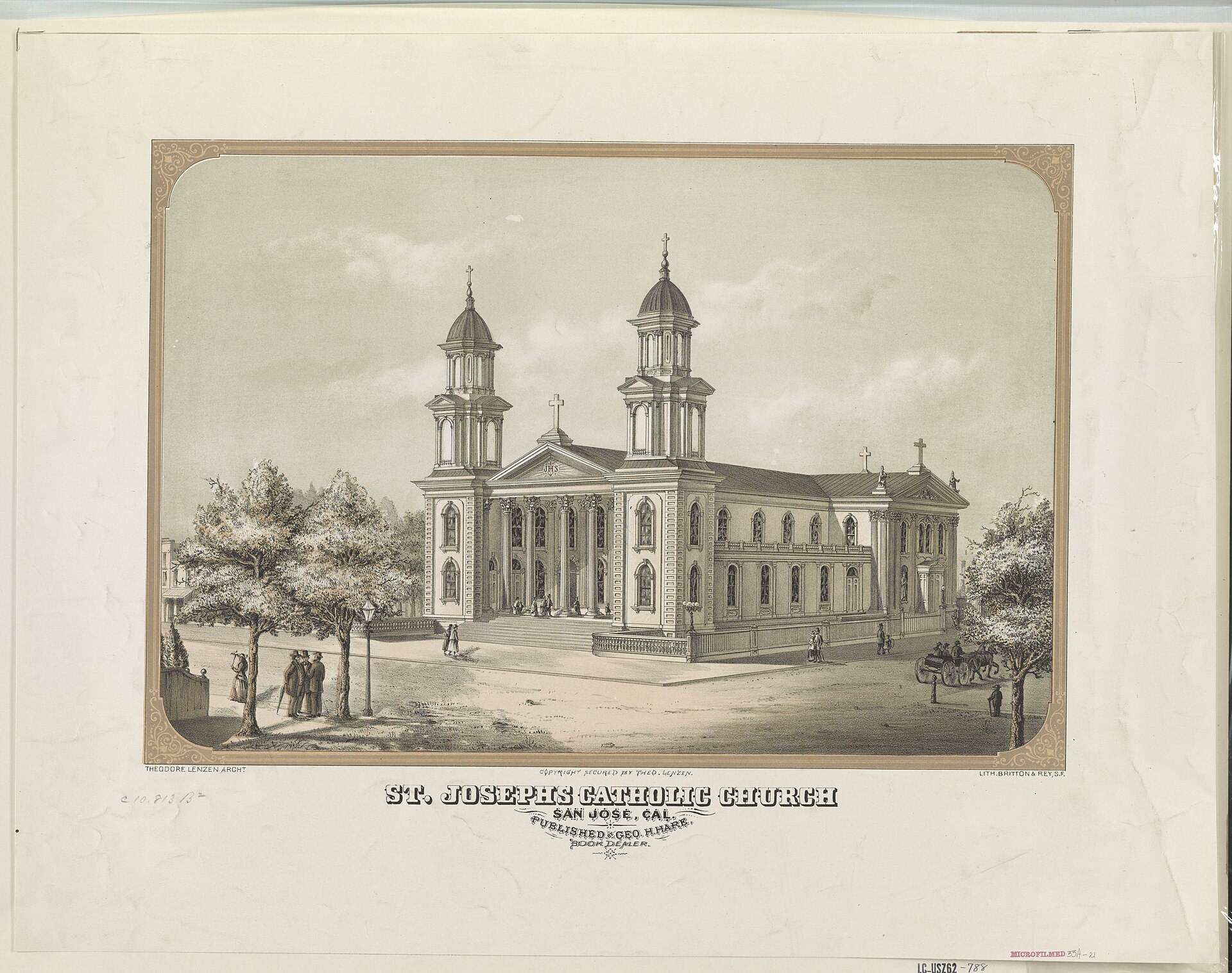
The first site flooded, so in the 1790s the pueblo moved about a mile south and grew around a plaza that is today’s Plaza de César Chávez [1] [4]. One of the founders, José Manuel Gonzales, built an adobe house around 1797 that still stands; named for its later owner Luis María Peralta, it is the oldest building in San José [3]. The pueblo’s first church, San José de Guadalupe, went up in 1803 on the site of today’s Cathedral Basilica of St. Joseph [25]. In 1792 the British navigator George Vancouver rode through the valley and compared it to a park “planted with the true old English oak” [6].
Ranchos and the Mexican pueblo
San José became part of independent Mexico in 1821 [1]. Between 1833 and 1845 the government made thirty-eight rancho grants in the Santa Clara Valley, fifteen of them inside today’s city limits [1]. By 1835 the pueblo had about 700 people, forty of them foreigners, mostly Americans and Englishmen [1]. An American traveler in 1846 found a village of six or eight hundred people, an adobe church he thought looked like “a huge Dutch barn,” and the orchard of Antonio Suñol heavy with grapes, pears, figs and oranges [8].
The flag and the first capital, 1846-1851
In July 1846, during the Mexican-American War, Captain Thomas Fallon led volunteers over the Santa Cruz Mountains, took the pueblo without bloodshed and raised the American flag over its juzgado on July 14 [5]. In 1849 San José was chosen as the capital. Its delegates had promised that the Legislature would be well housed, so nineteen citizens signed a note for $34,000 to buy a large adobe built as a hotel on Market Square, and it became the State House [6]. Bayard Taylor, riding in that year, found adobes, tents and new clapboard stores scattered over half a square mile [9].
The first Legislature met there in December 1849 [1]. It was a wet winter, the town had little housing, and the session became known as “the Legislature of a Thousand Drinks,” though both Hall in 1871 and later historians judged it one of the hardest-working legislatures the state ever had [6] [7]. San José incorporated on March 27, 1850, with Josiah Belden as its first mayor [1]. After the 1851 session the lawmakers took up Mariano Vallejo’s offer of a new capital, and the State House burned in 1853 [2] [6].
Quicksilver
In 1845 the Ohlone showed Andrés Castillero, a Mexican army captain, the source of their cinnabar in the hills south of town [11]. The New Almaden mines, named for the great mercury mine of Almadén in Spain, became the largest mercury mines in North America during the Gold Rush, supplying the quicksilver used to separate gold from ore [2] [10]. By 1865 the mining camps held 1,800 people in three settlements, and mining went on until 1975 [11] [10]. The mines are why the city’s newspaper is the Mercury News [2].
The Garden City
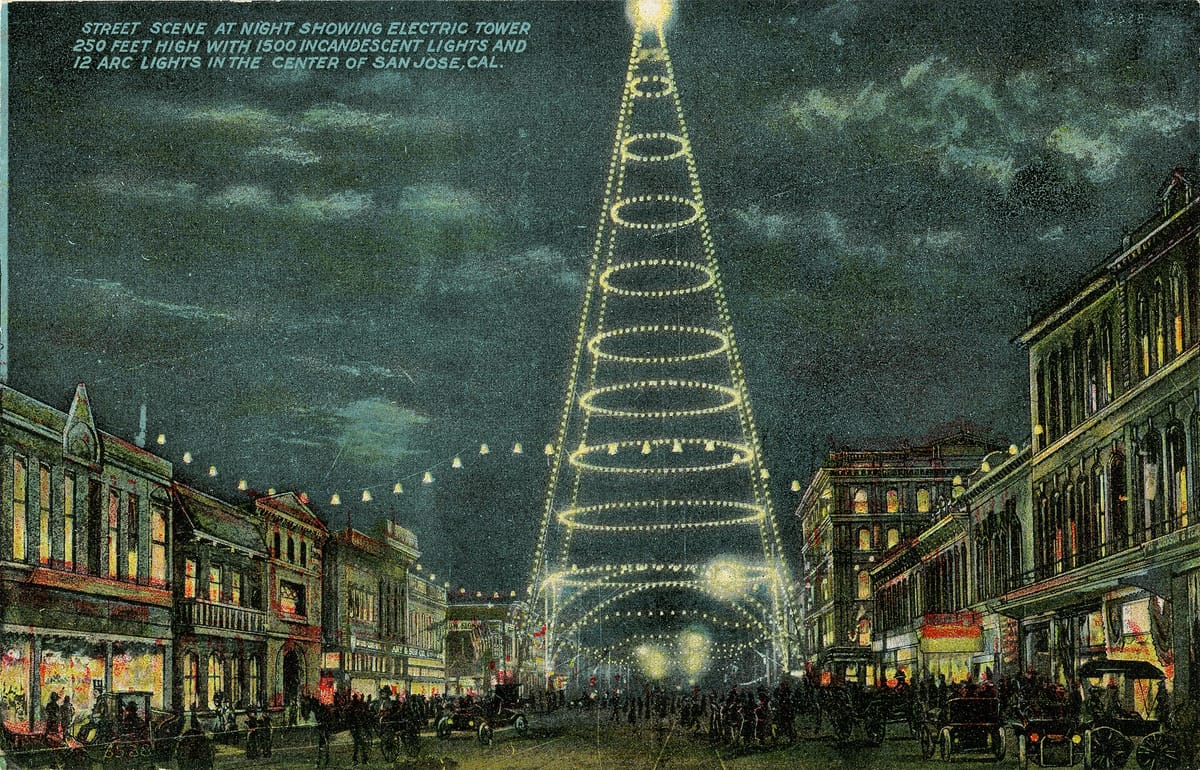
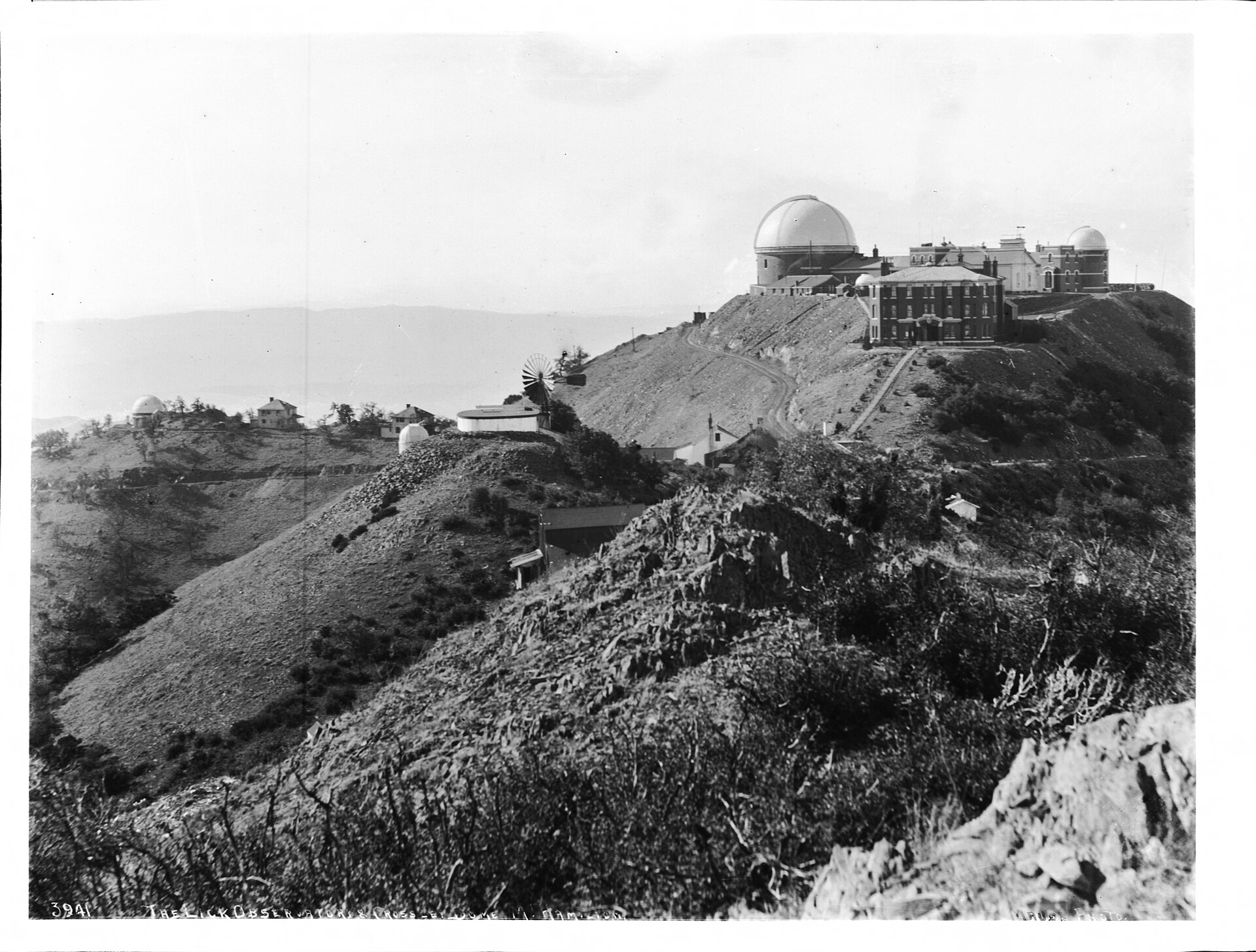
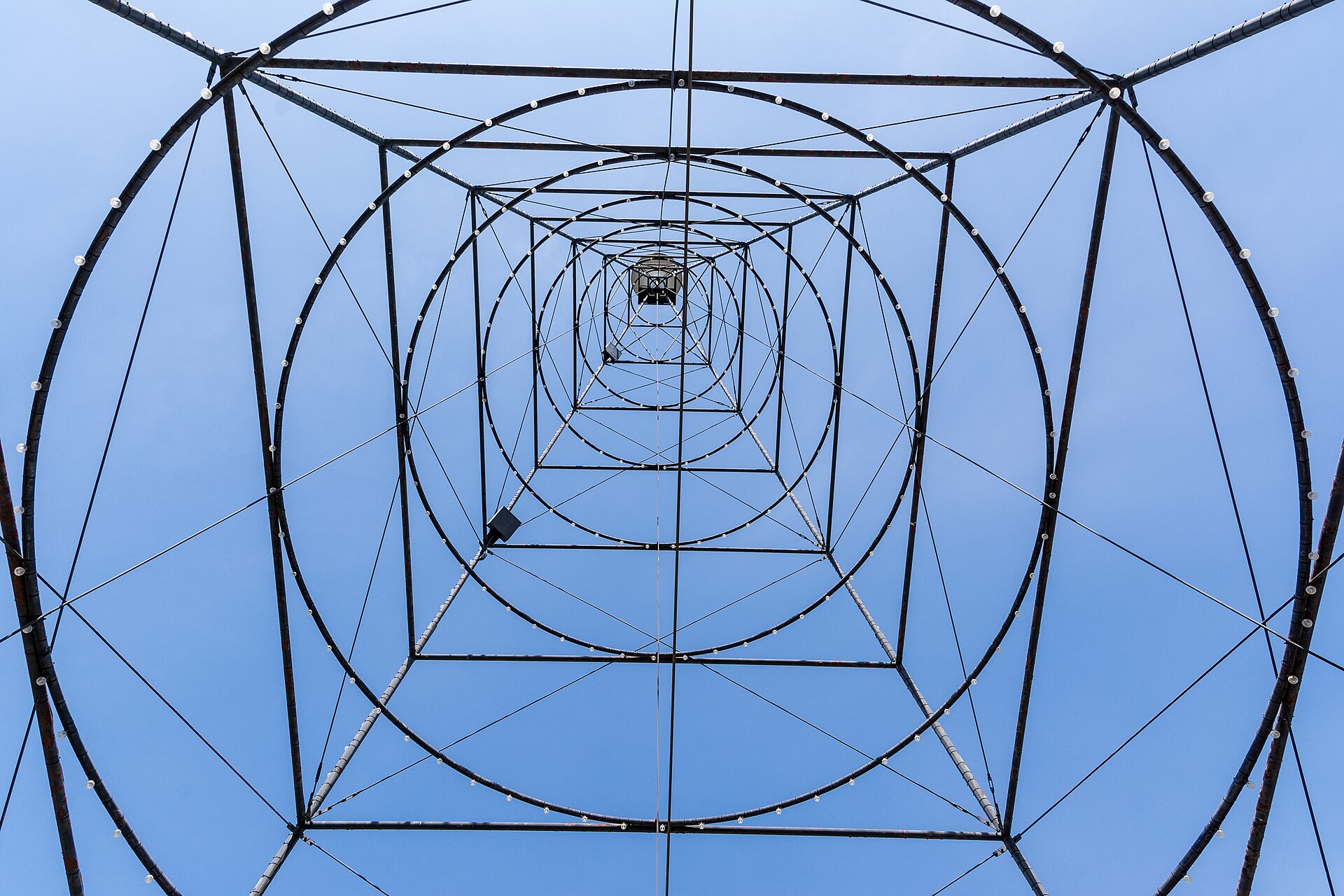
Railroads, schools and orchards built the town that followed. The state’s normal school, founded in San Francisco in 1857, moved to San José in 1871 and became San José State University, the oldest public university in the western United States [24]. In 1881 J. J. Owen of the San Jose Mercury raised money for a 237-foot electric light tower over Santa Clara and Market Streets; it stood until a windstorm in 1915, and a half-size replica now stands at History Park [12] [13]. Sarah Winchester bought a farmhouse west of town in 1886 and kept building it for the rest of her life [22]. On Mount Hamilton, James Lick’s observatory saw first light through its great 36-inch telescope in 1888 [23].
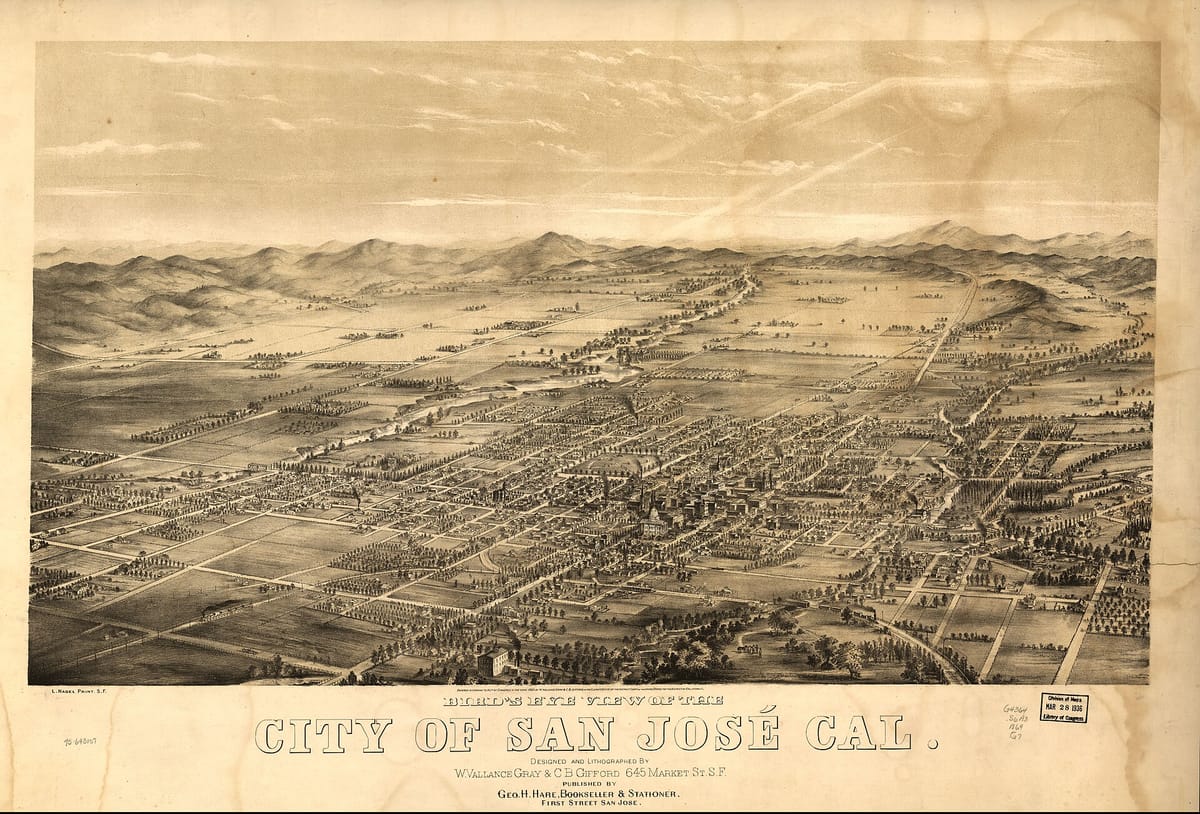
Prunes, apricots and cherries made the Santa Clara Valley the Valley of Heart’s Delight [2]. In 1904 the Chamber of Commerce boasted of 125 square miles of trees in bloom at once [16]. By 1915 the valley had more than 7.8 million fruit trees, and between the wars it had 18 canneries and 13 dried-fruit packing houses [15]. The first commercial broccoli in the United States was grown in San José in 1922 [2]. In 1909 Charles Herrold opened a wireless school downtown, and from 1912 his station broadcast regular weekly programs, among the first anywhere [14].
Neighborhoods that were towns
Much of today’s San José was once somewhere else. Alviso, the valley’s port on the bay, incorporated in 1852 and voted to join San José in 1968 [19]. Willow Glen became a city in 1927 to keep a railroad off Lincoln Avenue, then joined San José in 1936 for its sewers [17]. Japantown grew up beside Heinlenville, the Chinatown of 1887; during World War II its families were removed and incarcerated, and many came back after the war [18]. Alum Rock Park, set aside in 1872, is the oldest city park in California [20].
Dutch Hamann and the big city
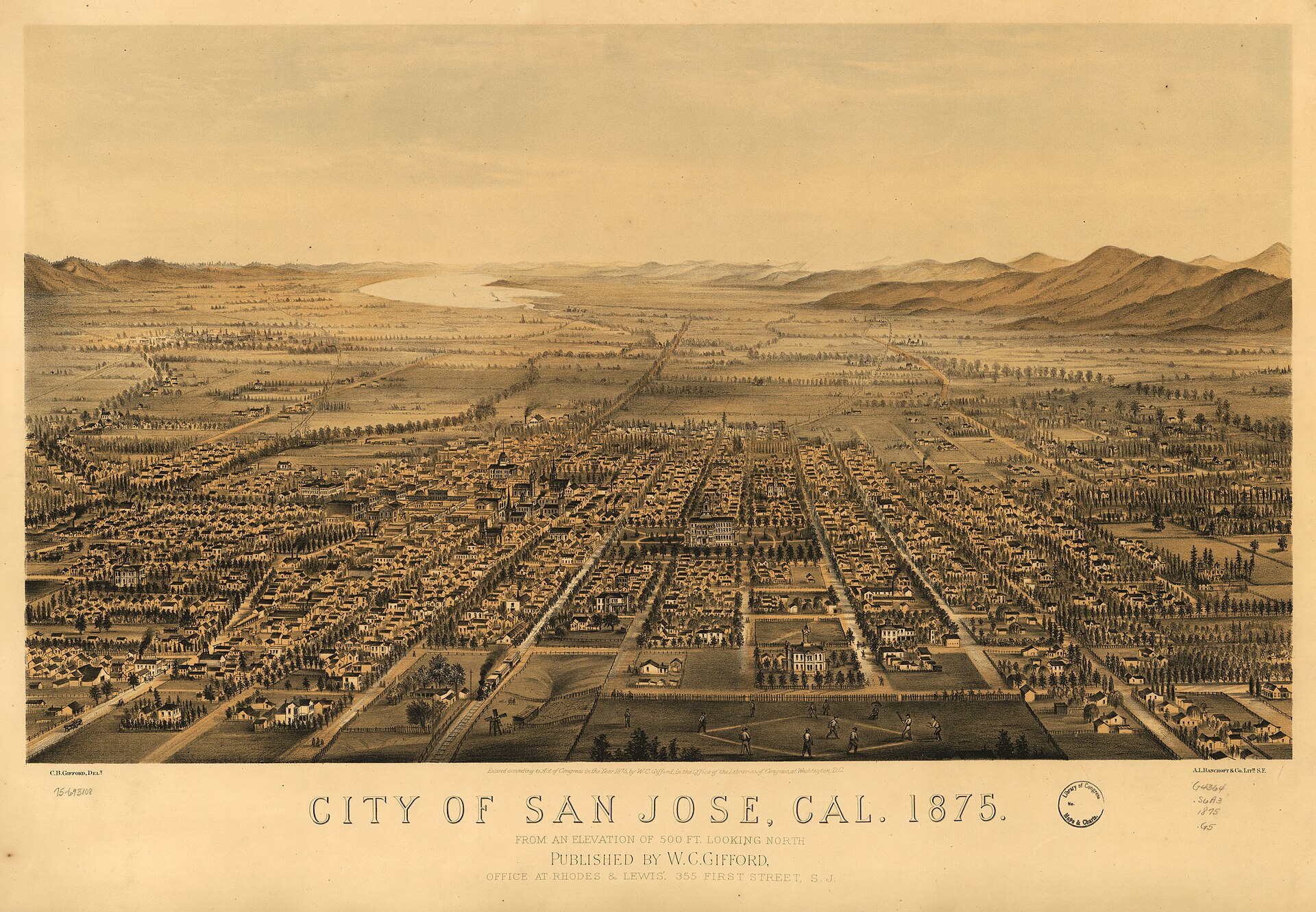
In 1950 San José had about 95,000 people on 17 square miles [2]. City manager A. P. “Dutch” Hamann annexed land along every main road, about 1,389 times by 1969, and the city grew to 149 square miles [1]. A new sewage plant on the bay drew business to the city, and when little Alviso tried to annex the plant, San José annexed Alviso instead [21]. In the 1970s voters turned toward slower growth, electing Norman Mineta and then Janet Gray Hayes as mayor [2].
IBM opened a plant downtown in 1943, and its San José lab invented the RAMAC and the hard disk drive [1]. As the orchards gave way to houses and offices, San José passed San Francisco in the 1990 census and took the motto “Capital of Silicon Valley” [1]. One family orchard, J&P Cosentino Family Farm, still grows fruit on two acres beside Highway 85 [26].
Today
About 990,000 people lived in San José in 2025, in a city of about 180 square miles [1]. More than 30 percent of residents are Hispanic, and San José has one of the largest Vietnamese communities outside Vietnam [1] [28]. Mayfair in East San José, where César Chávez lived in the 1950s, has long been a center of Chicano culture [27]. Salmon still run up the Guadalupe River, and Alviso, 13 feet below sea level, is the city’s only waterfront [1] [19].
Key dates
01
1777
The pueblo is founded
José Joaquín Moraga founds the Pueblo de San José de Guadalupe on November 29, California’s first civilian town. Source ↗
02
1797
A new plaza and an adobe
After floods, the pueblo grows around a new plaza, and José Manuel Gonzales builds the adobe that is now the city’s oldest building. Source ↗
03
1803
The first church
San José de Guadalupe church is built on the site of today’s Cathedral Basilica of St. Joseph. Source ↗
04
1845
Quicksilver
Andrés Castillero identifies mercury ore in the hills that become the New Almaden mines. Source ↗
05
1846
The American flag
Thomas Fallon raises the flag over the pueblo’s juzgado on July 14. Source ↗
06
1849
The first state capital
The first California Legislature meets in San José in December, in an adobe State House on Market Square. Source ↗
07
1850
A city
San José incorporates on March 27, with Josiah Belden as mayor. Source ↗
08
1872
Alum Rock Park
California’s oldest municipal park is set aside in the eastern foothills. Source ↗
09
1881
The light tower
J. J. Owen’s electric light tower is lit over Santa Clara and Market Streets on December 13. Source ↗
10
1888
Lick Observatory
The great 36-inch telescope on Mount Hamilton sees first light on January 3. Source ↗
11
1912
Regular radio
Charles Herrold’s San José station begins regular weekly broadcasts. Source ↗
12
1936
Willow Glen joins
Willow Glen’s voters choose, 978 to 871, to give up their nine-year-old city and join San José. Source ↗
13
1943
IBM arrives
IBM opens its first West Coast plant downtown; its San José lab later invents the hard disk drive. Source ↗
14
1968
Alviso joins
The old bayside port votes 189 to 180 to consolidate with San José. Source ↗
15
1990
The Bay Area’s biggest city
The census shows San José has passed San Francisco in population. Source ↗
Sources
1. San Jose, California — Wikipedia
2. History of San Jose, California — Wikipedia
4. Plaza de César Chávez — Wikipedia
6. The History of San José and Surroundings (Frederic Hall, 1871) — Internet Archive
7. The First State Legislature — San Jose Inside, Leonard McKay, 2006
8. What I Saw in California (Edwin Bryant, 1849 edition) — Internet Archive
9. Eldorado (Bayard Taylor, 1850) — Internet Archive
11. History of New Almaden — History San José
12. San Jose electric light tower — Wikipedia
13. Looking Back: San Jose’s Electric Light Tower — San José Public Library, 2013
14. Charles Herrold — Wikipedia
15. Looking Back: Canning in the Valley of Heart’s Delight — San José Public Library, 2013
17. Willow Glen, San Jose — Wikipedia
18. Japantown, San Jose — Wikipedia
19. Alviso, San Jose — Wikipedia
20. Alum Rock Park — Wikipedia
21. Dutch Hamann - Part One — San Jose Inside, Leonard McKay, 2006
22. Winchester Mystery House — Wikipedia
23. Lick Observatory — Wikipedia
24. San Jose State University — Wikipedia
25. Cathedral Basilica of St. Joseph (San Jose, California) — Wikipedia
26. One of San José’s Last Working Orchards Has Been Family Run Since 1945 — KQED, 2023
Further reading
The History of San José and Surroundings, with Biographical Sketches of Early Settlers, Frederic Hall (1871) — public domain, free to read online
What I Saw in California, Edwin Bryant (1849) — public domain, free to read online
Eldorado, or, Adventures in the Path of Empire, Bayard Taylor (1850) — public domain, free to read online
San José: The Garden City of the Santa Clara Valley, Charles Amadon Moody (1901) — public domain, free to read online
San José (San Hosay), Santa Clara County, California, San Jose Chamber of Commerce (1904) — public domain, free to read online
History of Santa Clara County, California, Eugene T. Sawyer (1922)
History of Santa Clara County, California, J. P. Munro-Fraser (1881)
Picturesque San José and Environments, H. S. Foote, C. A. Woolfolk (1893)
Reminiscences of Santa Clara Valley and San Jose, Amaury Mars (1901)
Clyde Arbuckle’s History of San José, Clyde Arbuckle (1986) — borrow it from the Internet Archive
San Jose’s Monument to Progress: The Electric Light Tower, Linda S. Larson (1989) — borrow it from the Internet Archive
San Jose Japantown: A Journey, Curt Fukuda, Ralph M. Pearce (2014) — borrow it from the Internet Archive
Japanese Legacy: Farming and Community Life in California’s Santa Clara Valley, Timothy J. Lukes, Gary Y. Okihiro (1985) — borrow it from the Internet Archive
Captive of the Labyrinth: Sarah L. Winchester, Heiress to the Rifle Fortune, Mary Jo Ignoffo (2010) — borrow it from the Internet Archive
Angle of Repose, Wallace Stegner (1971) — borrow it from the Internet Archive